
Clay
A security teammate for every employee.
 · 2026
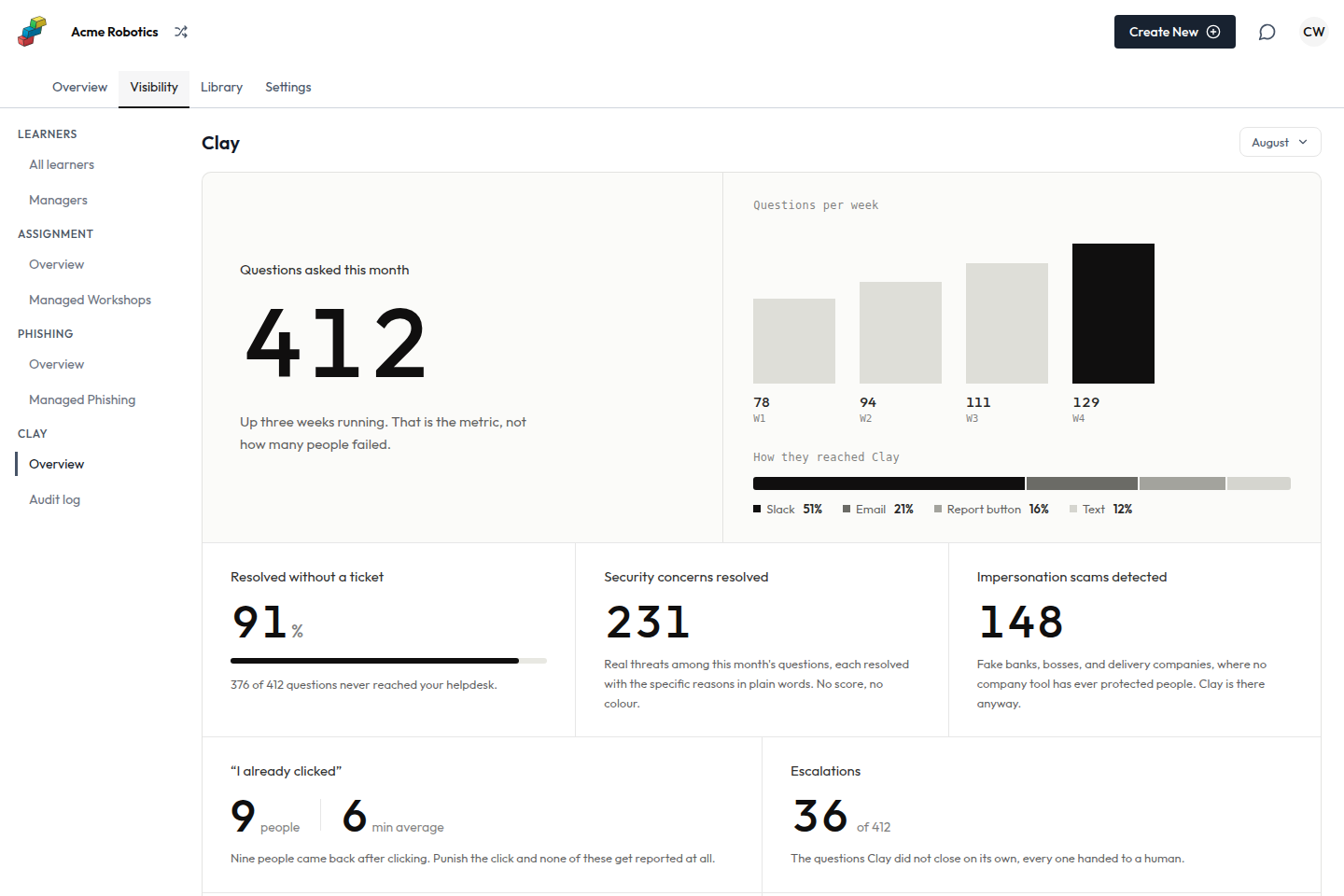

Results
Clay is the first agentic experience Huntress has shipped. It went from go to live in 8 weeks and was released to more than 1.2 million users.
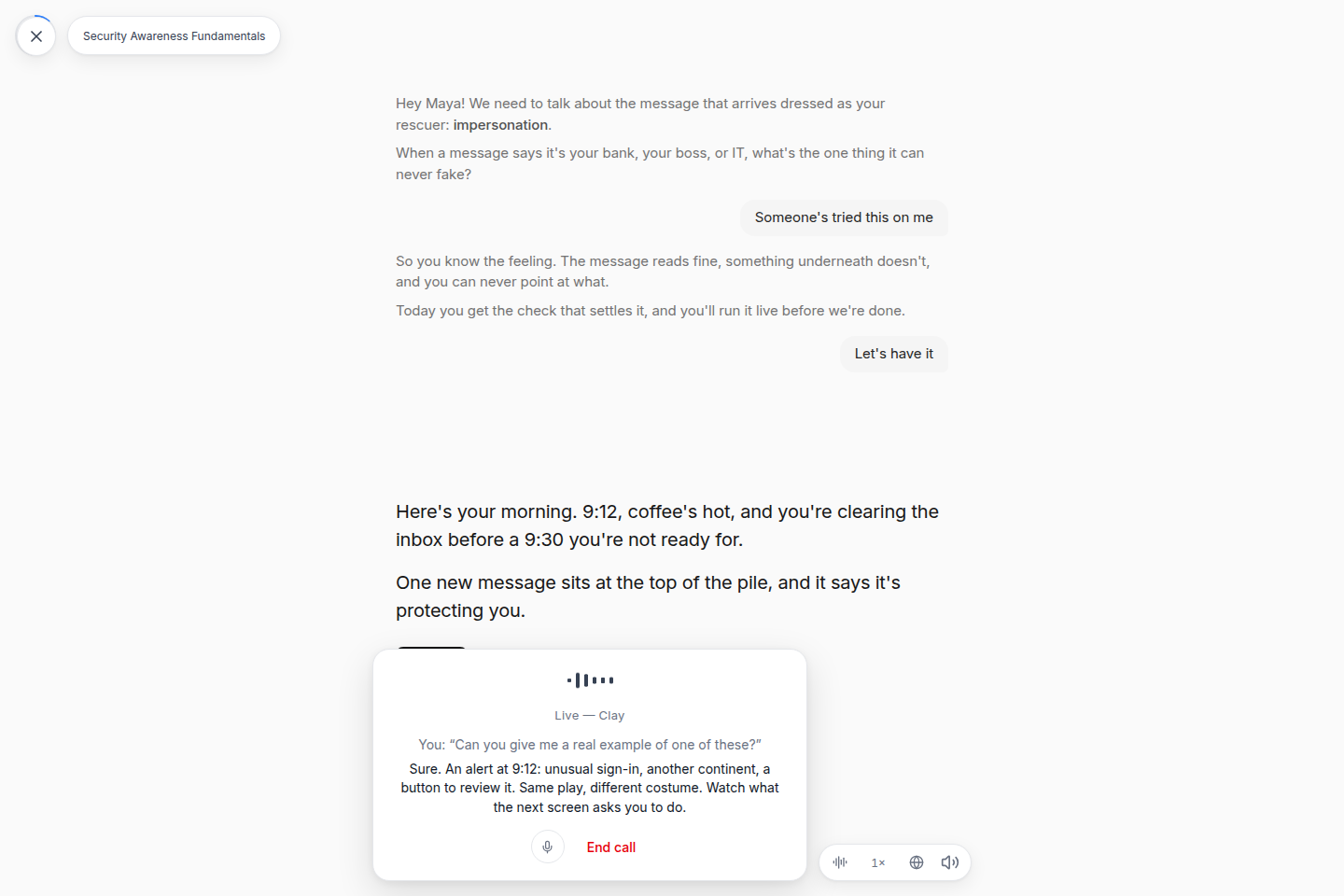
Learners now have an agentic experience across our platform and inside the tools they already use, like Slack and Teams, plus a personal line to Clay by email or text. It was shaped by what partners and learners told us along the way.
- Resolved without a ticket
- 18,420
- Security concerns resolved
- 42,615
- Escalated after a learner clicked
- 1,284
- Attacks that never reached an inbox
- 9,730
- Words spoken to Clay by voice
- 2.4M
Across every Huntress customer since launch.
My role
I was the only designer on Clay, from the first research call to shipped code. I surveyed more than 100 partners, the MSPs who run Huntress for their clients and act as its admins, and more than 6,000 learners. Then I got on calls with 12 partners and more than 15 learners, sometimes one person, sometimes six people from the same company.
I brought the team into those calls. An engineer, the PM, or whoever needed convincing heard our users in their own words, and we iterated on what they told us together.
I designed both sides of the product, the experience for learners and the report for admins, art-directed the clay brand, and built the front end: every screen, in production code, shipped by an agent swarm I run. The back end was built by the engineers on the team.
Team
We work together as a team, and everyone had an opinion on how Clay should be built. Dima (Principal product manager) trusted the team to run and weighed in at the key decisions. Eric (Senior manager, engineering) staffed it.
Truman (Principal threat researcher) built the threat library Clay answers from: every kind of phish, how Clay should respond, and what a learner should do next, including the steps for anyone who already clicked.
Aaron and Daniel (Principal software engineers), with Donna, Neil and Kevin (Senior software engineers), built the back end that runs Clay.
Built with
- React
- CBColoring Book design system
- HTML prototypes
- Figma
- Claude
- Slack
Clay is an app designed, developed and released to over 1.2 million users.
Helping people with security has never scaled, so the industry made content instead: videos, quizzes, fake emails to catch you out. Clay is the expert you can ask, in the workshop and in Slack, Teams, email and text.
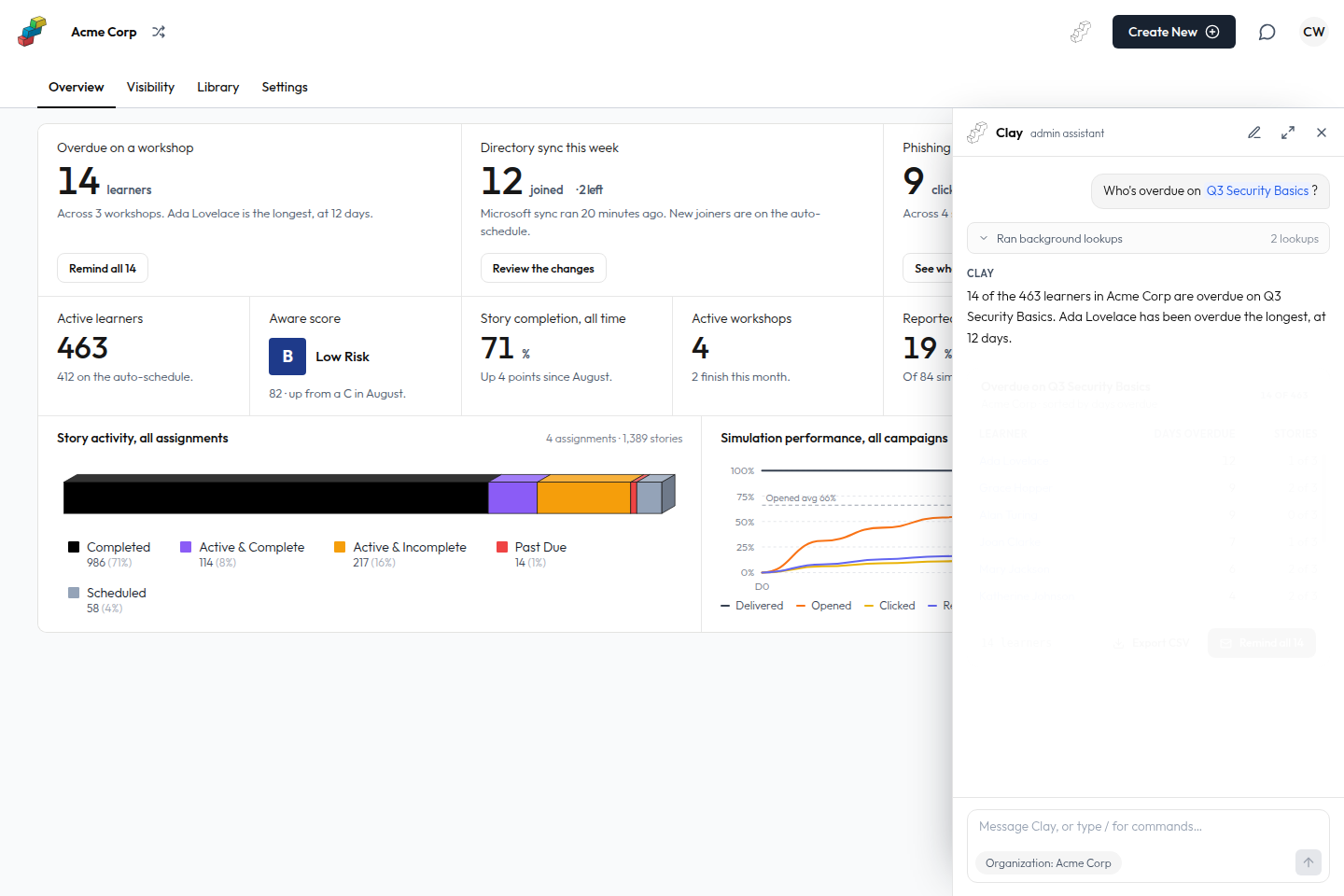
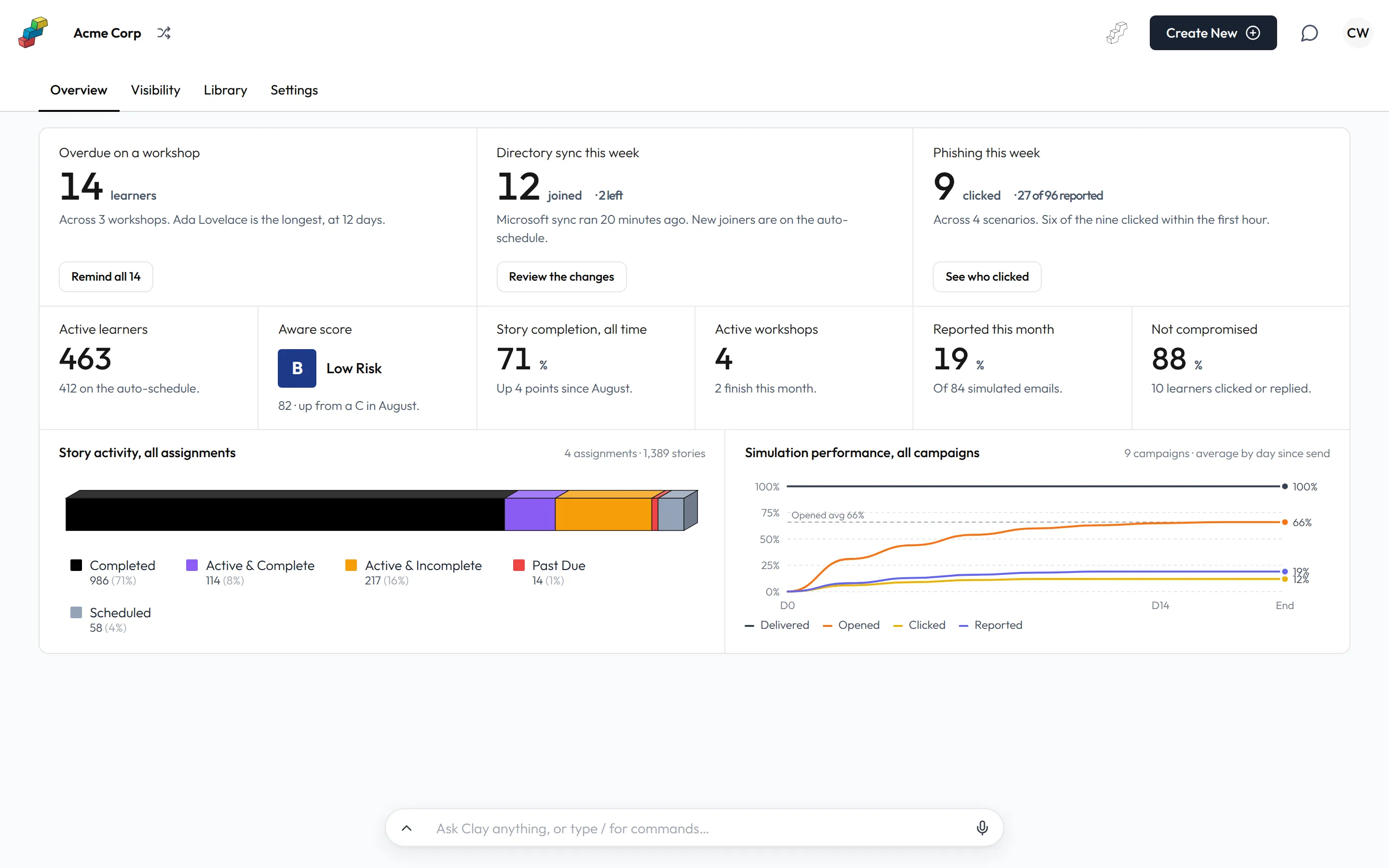
It's a B2B product with two sides. I designed both: the experience for learners and the one for their admins.
Where I started
Problem
When a suspicious message lands, there is nobody to ask in the moment. The help arrives later, as a video or a quiz, and it is the same for everyone. Admins see clicks and completions, not who needed a hand.
Hypothesis
If the expert is where people already are, in the workshop, in Slack, in Teams, in a text, people will ask before they act. And if the conversation stays private and the admin sees only what was caught, security gets the win without the words.
Goal
A security teammate for every employee: an answer in the moment, in the channel they are in. For the admin, a report that rolls the wins up live, with no leaderboards and no risk scores.
The brand is made of clay


Ask mid-workshop
A personal CISO for every employee
The same conversation in Slack, Microsoft Teams and SMS.
Admins get the win, never the words
The report inside the existing admin console. The nav stays put while the report scrolls.
Every number has four states
Every pixel is the real component
Settings → Clay: three channel states, and a security contact set in one place.
One designer. A fleet that ships.
Clay is live in Slack, Teams, email and text. Employees ask, Clay answers, and security teams get to brag about a person, not a finding.